Why Getting Leads Doesn’t Always Mean Getting Customers
Getting leads is often treated as the main goal of digital advertising. But a campaign can generate hundreds of leads and still produce very few customers.
The reason is simple: a lead is an opportunity, not a sale.
Someone filling out a form, sending a WhatsApp message, or calling your business has shown interest—but that does not automatically mean they are ready to buy. Between the first interaction and the final purchase, there are several stages where potential customers can lose interest.
What Is the Difference Between a Lead and a Customer?
A lead is someone who has shown interest in your product or service.
A customer is someone who has actually purchased from you.
For example:
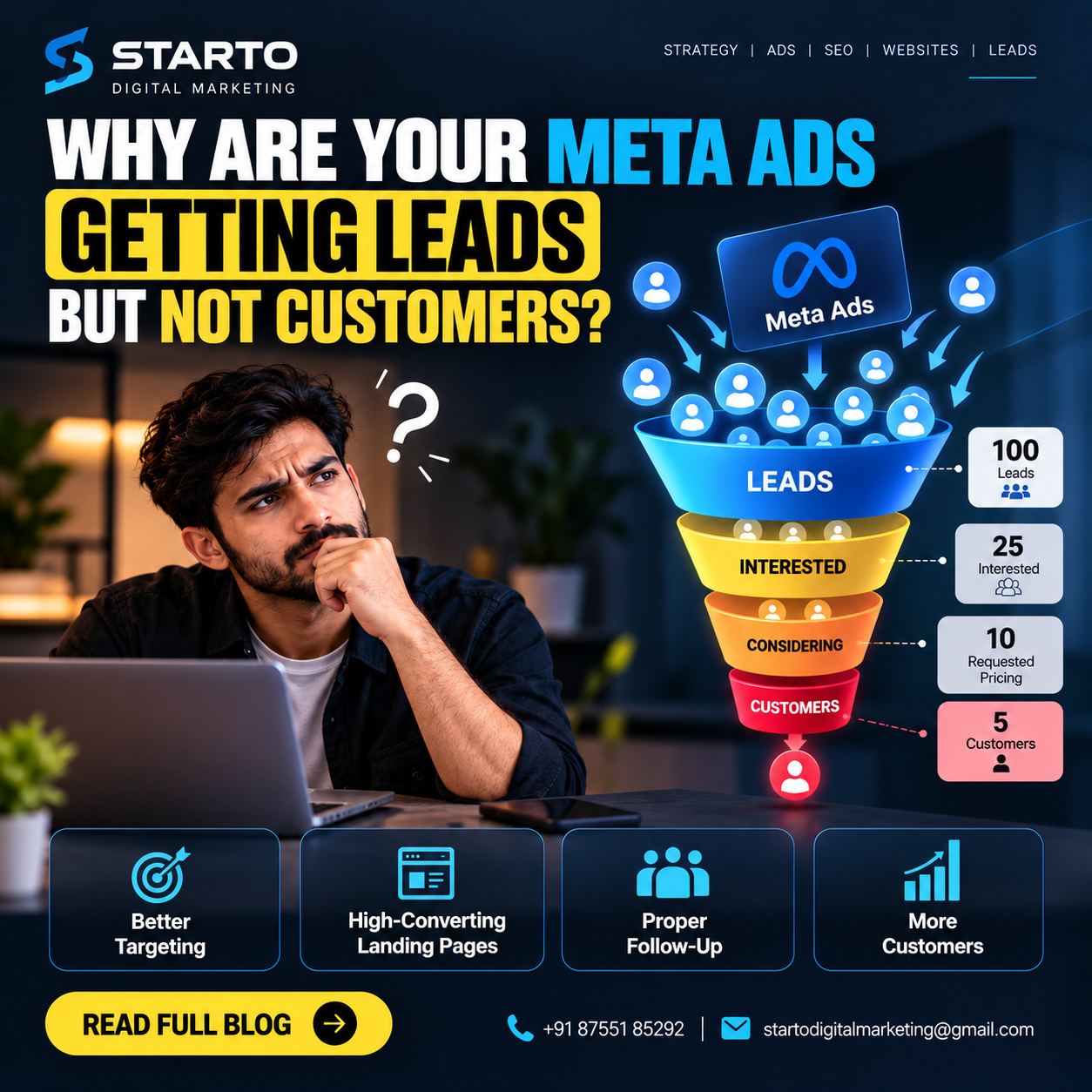
Your Meta Ad generates 100 leads.
60 people respond to your sales team.
25 are genuinely interested.
10 request pricing.
5 make a purchase.
In this example, the campaign generated 100 leads but only 5 customers.
This is why measuring only the cost per lead can give you an incomplete picture of campaign performance.
Why Leads Don’t Always Convert Into Customers
1. The Leads May Not Be Qualified
Not every person who clicks an advertisement is your ideal customer.
Your ad may attract people who are:
- Just researching
- Looking for the cheapest option
- Outside your service area
- Not ready to purchase
- Interested in something different from what you offer
Generating more leads isn’t necessarily the solution if the leads don’t match your target customer.
2. Your Ad May Promise Something Your Business Doesn’t Deliver
Your advertisement creates the first expectation.
If the ad says:
“Get a Free Consultation Today”
but the customer discovers that the consultation is actually a sales call, the experience can immediately create friction.
Your ad, landing page, offer, and sales conversation should communicate the same message.
3. Your Landing Page May Be Losing Potential Customers
Getting someone to click your ad is only the first step.
If your landing page is:
- Slow
- Confusing
- Difficult to navigate
- Missing important information
- Lacking trust signals
- Filled with too many distractions
the visitor may leave before taking the next step.
A good advertisement cannot compensate for a poor post-click experience.
4. Your Sales Team May Be Responding Too Slowly
Lead generation and sales are connected.
If someone submits a form and doesn’t receive a response for several hours—or even the next day—their interest may have changed.
A lead should enter a clear follow-up process immediately.
5. There May Be No Follow-Up System
Many businesses contact a lead once and stop when they don’t receive a response.
But customers may need multiple interactions before making a decision.
Follow-up can include:
- Phone calls
- WhatsApp messages
- Emails
- Retargeting ads
- Helpful information
- Offers or incentives
- Case studies and testimonials
The objective isn’t simply to contact someone repeatedly. It is to help move the potential customer toward a buying decision.
Look Beyond Cost Per Lead
One of the biggest mistakes businesses make is judging an advertising campaign only by its CPL—Cost Per Lead.
For example:
| Campaign | Leads | Cost/Lead | Customers |
| Campaign A | 100 | ₹100 | 3 |
| Campaign B | 50 | ₹180 | 8 |
Campaign A generates more leads at a lower cost per lead.
But Campaign B generates more customers.
This is why businesses should track the complete journey:
Ad → Click → Lead → Qualified Lead → Sales Conversation → Customer
The real question isn’t:
“How many leads did we generate?”
It is:
“How many qualified leads became customers?”
Build Your Marketing Around the Entire Funnel
A strong lead-generation strategy doesn’t stop when someone submits a form.
Your business should have a system for:
1. Attracting the right audience
↓
2. Capturing their information
↓
3. Qualifying the lead
↓
4. Following up quickly
↓
5. Building trust
↓
6. Converting the lead into a customer
↓
7. Measuring the final result
When you track every stage, you can identify exactly where potential customers are being lost.
Conclution
More leads don’t automatically mean more sales.
If your business is generating leads but struggling to convert them, the problem may not be your advertising campaign alone.
It could be your:
- Audience targeting
- Offer
- Lead quality
- Landing page
- Follow-up process
- Sales process
- Trust-building
- Conversion tracking
Instead of asking “How can we get more leads?”, start asking:
“How can we turn more of the right leads into customers?”
That shift changes the way you approach digital marketing—from simply generating activity to building a measurable path from advertising to revenue.